

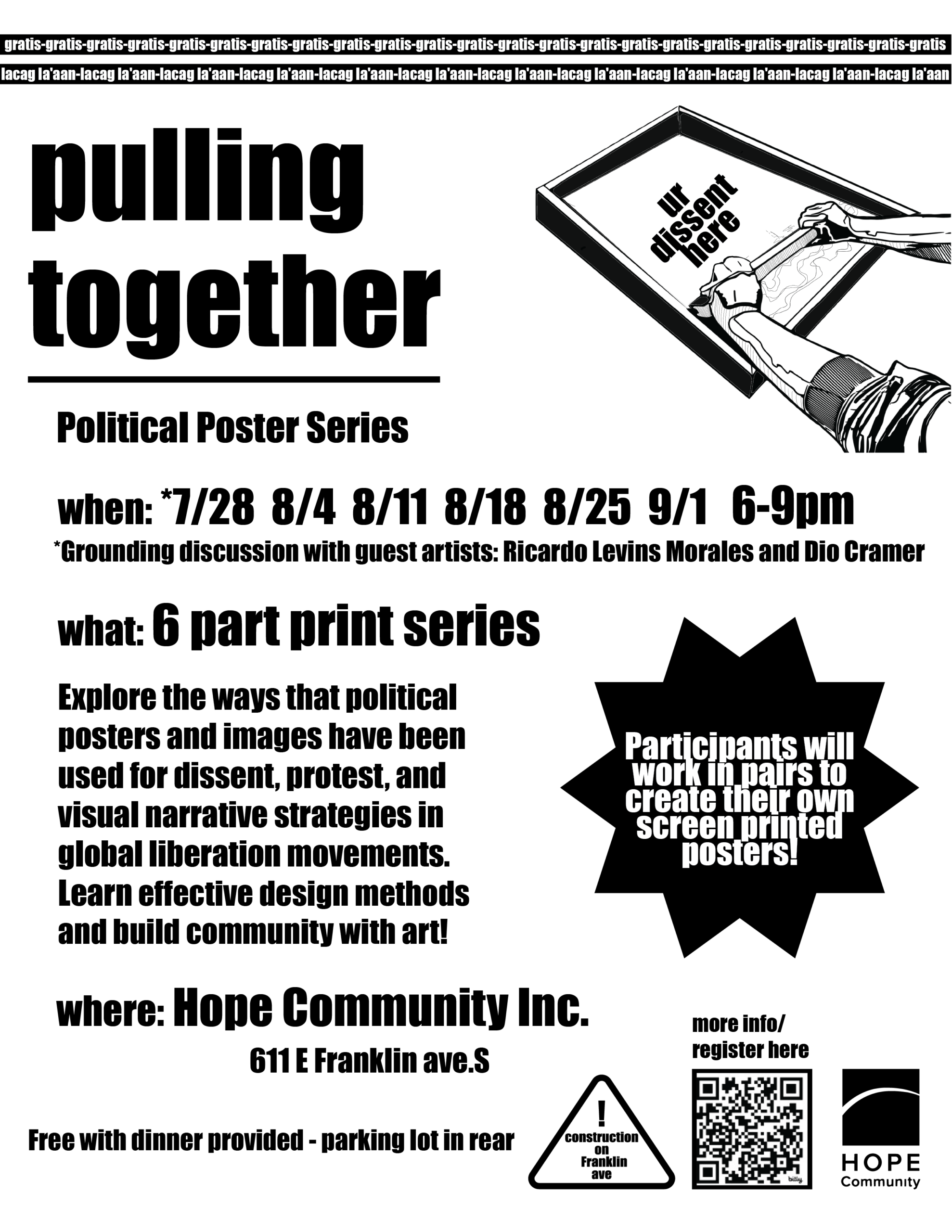
How have organizers used print, posters, and visual strategies to make transformative change? Printmaking has long served as an accessible means for expressing dissent and visions of change!
In this series of workshops, we will discuss this context and some principles that make effective political poster designs, including what makes a strong image and narrative. Participants will work in pairs to develop collaborative messaging and design a poster using their choice of drawing, digital, scratchboard, and more. All designs will then be made into silk screens that participants will screen print in the final session.
Participants will self-select a collaborator at beginning of the workshop series. You can sign-up solo and we will facilitate making pairs or you can sign up with a friend, co-worker, neighbor, etc, and work together!
This series is ideal for artists and organizers, and anyone wanting to gain the skills of designing, strategizing, and utilizing posters for social justice efforts. We believe anyone can create and use political posters to impact their communities and efforts and are excited to share these skills together. 18+, all welcome regardless of artistic experience.
Each session builds on previous ones and is intended as a full course with participants attending all sessions.
Series is free, with dinner provided. Registration required, space is limited.
Series Details
Location: Hope Community: 611 E Franklin Ave, Minneapolis, MN 55404
Dates: Tuesday Evenings, 6-9pm.
July 28: Session 1- Grounding in context and design principles
August 4: Session 2- Workshopping. Ideating. Feedback. Begin Art.
August 11: Session 3- Design Continued, Workshop and Cont. Art.
August 18: Session 4- Art Design
August 25: Session 5- Art Design
September 1: Session 6- Screen Printing Day!
“It can be intimidating to try a medium in a new group of people. This series was really scaffolded well to build relationships, confidence, get over doubt and try a new skill. I not only had fun but felt pushed and supported. Having political messaging was especially critical because we need more art to help us dream and see new possibilities despite dark times.” Program participant, Cycle 1